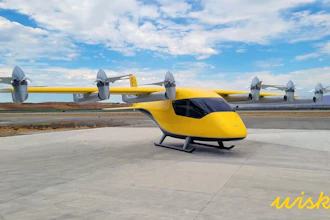
Heart Aerospace today announced the successful first flight of the company's X1 demonstrator aircraft. Spanning 106 feet, measuring 76 feet nose to tail, and weighing more than 25,000 pounds at takeoff, X1 is the largest battery-electric aircraft ever flown.
The flight took place on Wednesday, August 12th, 2026, at Heart's X1 flight-test base at Plattsburgh International Airport, a regional commercial airport serving a community of 20,000 people in upstate New York. The piloted mission lasted 27 minutes, during which X1 reached an altitude of 1,100 feet AGL and its all-electric propulsion system delivered more than one megawatt of power.
The flight was conducted under an FAA Special Airworthiness Certificate in the Experimental Category (SAC-EC), with a test profile that included taxi, takeoff, climb, maneuvering, and landing. The mission was designed to demonstrate all-electric flight at a scale relevant to commercial airline operations.
Powered entirely by batteries, X1 used approximately $5 worth of electricity during its first flight. The flight came amid a sustained surge in global jet fuel prices, which averaged $3.50 per gallon for the week ending August 7, up 63% year over year, highlighting the potential for electric propulsion to deliver structurally lower aircraft operating costs while decoupling airlines from the volatility of global oil markets.
X1 is a full-scale demonstrator representative of Heart's ES-30 production aircraft, designed to validate key technologies, aerodynamics and flight performance, and Heart's organizational capabilities. The ES-30 is a conventional fixed-wing, 30-seat hybrid-electric regional airliner being developed for FAA Part 25 certification. It has attracted customer commitments from major air carriers including United Airlines, Air Canada, and JSX.
With entry into service targeted for 2031, Heart expects the ES-30 to reduce aircraft operating costs by more than 40% compared with legacy regional aircraft. This reduction is driven by lower energy costs, reduced maintenance requirements from simplified electric propulsion and electrified flight systems, and greater aircraft uptime and reliability enabled by an integrated electronics and software architecture.
Heart foresees this cost advantage widening over time through advances in battery technology, technology-enabled gains in crew efficiency, and the ES-30's low exposure to a growing range of emissions-related aviation taxes and fees worldwide.
Heart is currently developing the first pre-production ES-30 at its pilot manufacturing plant in Los Angeles, with flight testing scheduled to begin in 2028.