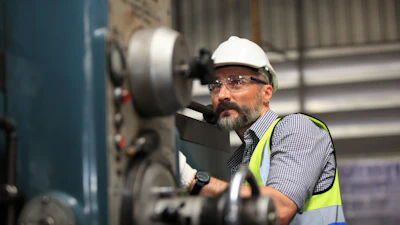
The people who keep America’s factories running rarely show up in headlines or jobs reports. They’re the maintenance technicians, reliability engineers, and plant supervisors carrying modern manufacturing forward one shift, one repair, and one hard-earned workaround at a time. And most of them are quietly dealing with a version of the same problem: their teams are smaller than they were a year ago, the equipment hasn't gotten simpler, and nobody has a good answer for how to close that gap.
That was the backdrop before the April jobs report came out on Friday. Then the data caught up with the reality inside the plants.
The headline was stronger than many economists expected: the U.S. economy added 115,000 jobs, and unemployment held at 4.3%. But manufacturing payrolls still declined by 2,000 jobs in April. Economists had called for a gain of 5,000. That's a 7,000-job miss in a sector that has now shed more than 80,000 positions since January 2025. At some point, you stop calling it a trend and start calling it a restructuring.
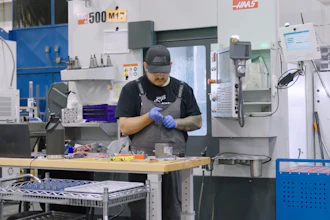
On an actual plant floor, it looks like the following: the guy who retired in March didn't get replaced. His team went from eight people to five. The new tech is capable, but he's still learning the equipment, and the only documentation anyone can find is a three-ring binder that hasn't been touched since 2011.
The reasons vary by sector and company, but one theme that consistently comes up in conversations across operations teams is uncertainty. When manufacturers can't predict input costs month to month, they don't staff up; they pull back. Orders come in smaller increments. Capital decisions get deferred. And when something has to give in the short run, it's usually headcount.
According to the Bureau of Labor Statistics (BLS), the year-over-year gain in manufacturing productivity through Q3 2025 was the strongest since 2011. The Federal Reserve's G.17 report puts total industrial production at its highest level since 2019. We are making more stuff. We just have fewer people making it.
That's the part that operations leaders should pay attention to.
When facilities run leaner, the physics of maintenance change. A compressor failure that a well-staffed team absorbs in three hours becomes a day-long event when you don't have the coverage. Preventive maintenance that slips a week because everyone's running hot doesn't get rescheduled; it just doesn't happen. Eventually, something fails that shouldn’t have, and the root cause analysis sounds painfully familiar: the team knew there was a problem, but nobody had time to address it before downtime hit.
Operations leaders across manufacturing are seeing versions of that story play out regularly. Honestly, sometimes the right answer is that they need more people. No software can fully compensate for a critical labor shortage.
But a lot of the time, the underlying problem isn't simply headcount. It's information. Too many plants still rely on paperwork orders, tribal knowledge, or disconnected systems where important data gets buried in someone's email. No full maintenance history for a critical asset because it was used across three systems during two acquisitions. A PM schedule that exists but that nobody is accountable to in any systematic way, and no data to prove whether it's working or not.
That's a solvable problem. And solving it matters a lot more when you can't afford for things to go wrong.
The manufacturing organizations navigating this period most effectively tend to share a few common traits. They treat maintenance data as an operational asset, not an administrative chore. They've gotten serious about PM compliance, not as a checkbox, but because they've seen what happens to asset life when it slips. And they've made a deliberate decision that when a veteran tech walks out the door, at least the knowledge doesn't walk out with him.
Importantly, there are also signs of optimism beneath the surface of the latest labor data. While factory payrolls were down slightly in April, manufacturing still recorded roughly 462,000 open positions in March, according to federal JOLTS data, an increase from the previous month. Plant-adjacent skilled trades also continue to show resilience. Electricians, HVAC specialists, welders, pipefitters, and industrial installers added jobs in April even as broader factory employment softened, and the BLS continues to project strong long-term demand for installation, maintenance, and repair occupations as retirements accelerate and facilities modernize.
That matters because manufacturing’s future will not simply depend on adding more people. It will depend on making leaner teams more effective, connected, and easier to onboard. The manufacturers that succeed will be those that equip technicians with systems that preserve institutional knowledge, reduce friction, and help workers spend less time chasing information and more time solving problems. That is especially important for a younger generation entering the trades, expecting mobile tools, searchable maintenance histories, and workflows that actually make the job easier.
None of that is really about chasing the latest technology trend. Some of it requires new tools. Much of it requires a cultural shift that's honestly harder than any software implementation. But you have to start somewhere, and right now, with margins tighter, teams smaller, and the cost of downtime higher than it's been in years, starting is not optional.
The leaner factory is already here. It showed up in the jobs report on Friday and will keep appearing in the months ahead. The question is whether manufacturers are building resilient structures to get ahead during this shift, or just running harder until something breaks.
 Gary Specter is the CEO of Limble.Limble
Most recently, Specter served as CEO of Simpro Group, where he led the company through significant growth, operational transformation, and global expansion. Prior to Simpro, Specter was president of Cart.com and held senior leadership roles at Adobe, Magento, NetSuite, IBM, and Baynote, leading large-scale sales, growth, and customer success organizations worldwide.