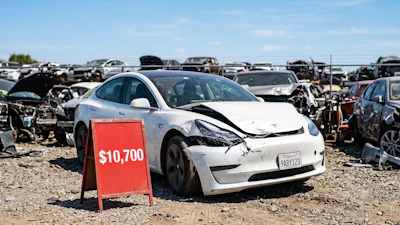
A Better Bid, a registered Copart auction broker providing access to salvage and clean-title vehicle auctions, released internal data that uncovered an underreported corner of the electric vehicle boom: What happens to these high-tech cars after a total loss?
In 2019, Teslas represented 0.31% of all listings on the platform. By 2022, that share jumped to 1.05%, climbing to 1.27% in 2025. The real acceleration hit in the first half of 2026, with Tesla volume spiking to 2.34% of all platform inventory, nearly doubling the pace of the previous year.
As millions of Teslas flood American highways, their presence in salvage yards is growing at an unprecedented rate.
The data also reveals a distinct anatomy of EV accidents. Front-end collisions dominate the platform's inventory, accounting for 162 of the 367 recorded Tesla lots—more than twice the rate of rear-end impacts (75 lots) and five times that of side impacts (32 lots). Minor dents and scratches accounted for 29 lots, followed by flood damage (15 lots), all-over damage (14 lots) and hail (7 lots).
Despite structural destruction, these vehicles defy traditional salvage pricing. The median winning price for a ruined Tesla sits at a staggering $10,700, nearly triple the platform-wide median of $3,850. Fueled by global demand for intact battery modules, electric drive units and reusable tech, rebuilders and EV specialists treat these wrecks as valuable goldmines rather than scrap metal.
Finally, the numbers confirm a stark reality: The salvage EV market is effectively a single-brand ecosystem. Competing EV makers like Rivian (10 lots), Polestar (5 lots) and Lucid (2 lots) remain virtually invisible on auction blocks, leaving Tesla as the sole titan of the high-value salvage market.
Figures are based on A Better Bid's internal records for 367 Tesla vehicles (232 with a recorded winning price) processed between January 2019 and June 2026. This data reflects platform transaction patterns and correlates with broader EV fleet growth; it does not measure national accident rates.