AI layoff headlines are dominating the conversation about the future of work. Block slashed 4,000 jobs, saying AI reduced its need for human labor. Pinterest and Dow blamed AI after laying off thousands of employees. A new report warns that 30% of jobs could disappear as AI displaces workers.
These headlines aren’t wrong—but they’re being misread. Job displacement driven by AI isn’t a scandal. It’s the pattern of every transformative technology in history. The Industrial Revolution didn’t just change which jobs existed; it raised living standards across the board by making each worker dramatically more productive.
The same dynamic is playing out now, and the industrial sector is where you can see it most clearly. Some companies are using AI as cover for long-overdue corrections to pandemic-era overexpansion—cutting costs without building anything.
The real question worth asking isn’t whether AI will eliminate roles. It will, and in many cases, it should. Most jobs won’t be destroyed by AI but transformed. Organizations should be building toward a future where better-equipped and AI-empowered workers do more valuable and impactful work—not simply cutting costs without building anything. The difference between those two paths will define who wins the next decade.
The Industrial Revolution Parallel: What’s the Real Lesson?
When mechanized looms arrived in textile mills, they didn’t just displace handweavers; they enabled a single skilled operator to produce what previously took dozens of workers. Output per person exploded. Wages eventually rose. Living standards improved in ways that would have been unimaginable to the generation before.
The transition was painful in places and for people who couldn’t adapt, but the net outcome was transformative progress.
AI is following the same logic. One person with the right AI tools can now do the work of five or ten. The companies that understand this aren’t asking how to keep headcount flat. They’re asking a different question: How do we enable each person we have to operate at dramatically higher leverage?
The industrial sector is where this question is being answered most rigorously—and for structural reasons that make it an instructive model for every other industry.
Why Industrial Leaders Are Building AI Differently
Industrial organizations aren’t taking a different approach to AI because they’re more enlightened. They’re doing it because the math of their workforce situation demands it.
The retirement wave is already here. American manufacturers will need 3.8 million new workers by 2033, with half those roles at risk of going unfilled—not because of layoffs, but because experienced workers are retiring out of the workforce. Decades of institutional knowledge, operational expertise, and hard-won judgment are walking out the door.
AI isn’t the threat to these organizations; it’s the only credible solution. The imperative isn’t to replace workers with AI. It’s to capture what experienced workers know and make that intelligence accessible to everyone who comes after them.
The work demands human judgment that is augmented, not replaced. Industrial AI powers high-stakes physical processes in real time: production schedules, safety systems, and maintenance protocols where errors have immediate physical consequences.
You can’t abstract away the human in these environments, but you can make each human dramatically more capable. A technician who once needed twenty years of experience to diagnose a complex equipment failure can, with the right AI tools, do it in a fraction of the time. A planner who once managed one facility can coordinate across three. That’s the force multiplier effect in practice.
Proprietary data creates defensible advantages. Generic AI models run on public data, which makes automating standard knowledge work relatively simple. Industrial data is different: trapped in proprietary systems, paper records, and the tacit knowledge experienced workers carry.
Organizations that successfully capture and learn from that operational intelligence build AI capabilities that competitors can’t replicate. Companies that lay off the people who generate those insights before capturing what they know are burning their own fuel supply.
What Does Workflow-First AI Look Like in Practice?
The tech sector’s approach to AI often starts with a question: What can we automate?
The industrial model starts with a different question: Where can we make each person ten times more effective?
Across industrial operations—maintenance, production planning, inventory management, quality assurance, and operational execution—this approach follows a consistent pattern:
- Organizations first digitize frontline workflows using mobile tools that track work orders, capture institutional knowledge, and coordinate teams in real time.
- Those digital workflows then become the foundation for specialized AI that surfaces relevant information, streamlines decision-making, and supports workers at the point of action.
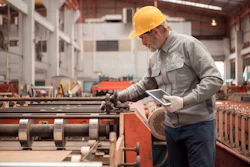
Take maintenance as one example. Many technicians still rely on paper-based systems, and vital institutional expertise often goes unrecorded. By digitizing these workflows, organizations create a living repository of operational knowledge.
AI then maps onto that digital layer to recommend procedures, flag anomalies, and help technicians solve problems faster. A senior technician who once held irreplaceable diagnostic knowledge in their head becomes, with AI assistance, the architect of a system that encodes that knowledge so every technician on the floor can access it.
The experienced worker doesn’t become redundant; they become a multiplier for everyone around them and for whoever fills their role after they retire. Technicians embrace these tools because the tools make their jobs better, not more precarious.
The same logic applies across the industrial enterprise:
- Production planners use AI-enhanced scheduling tools that learn from historical output data.
- Quality teams apply pattern recognition to inspection workflows.
- Operations leaders synthesize insights from across the facility to make faster, better-informed decisions.
This creates what I think of as the workforce intelligence flywheel: AI tools improve frontline operations, frontline activity generates richer data, and that data makes AI tools more capable over time. Each cycle expands the organization’s operational intelligence.
And crucially, the goal isn’t the same number of workers doing the same work more efficiently; it’s a smaller number of more capable workers moving up the value chain entirely. Human workers aren’t sidelined by this flywheel—they’re the engine that drives it to a higher level.
The Results Speak for Themselves
This isn’t a theoretical argument. The data shows that workflow-first AI adoption outperforms the productivity-only approach that dominates tech sector headlines.
Companies that center AI adoption on human workflows and workforce integration are seeing 2.3X greater shareholder returns than those focused narrowly on efficiency gains. While 95% of AI pilot projects across the broader economy fail to deliver meaningful ROI—often because team members resist tools that threaten their roles—85% of manufacturing CEOs expect their AI initiatives to deliver positive ROI within two years, and 93% are confident they can scale.
The difference isn’t luck or lower expectations. It’s that industrial AI adoption is structurally aligned with the way durable value gets created: incrementally, collaboratively, and in direct service of the people doing the actual physical world work.
What Should Every Leader Take from the Industrial Model?
The industrial sector’s experience with AI isn’t just relevant to manufacturing. It offers a blueprint for any organization trying to move beyond pilot projects and AI theater toward real, scalable impact.
Stop defending headcount and start building leverage. The companies that will win aren’t the ones that preserved the most jobs through the transition; they’re the ones that moved their people up the value chain fastest. The goal isn’t to protect roles from AI.
The companies scaling AI successfully are asking how deeply they can embed AI into the way work actually gets done—and how to ensure that every person remaining is operating at a level of impact that wasn’t possible before.
Capture knowledge before it walks out the door. Every organization’s most valuable data isn’t on the public internet; it’s in the knowledge, decisions, and workflows of its people. Every organization is facing some version of a retirement wave. The window to encode what experienced workers know is narrowing.
AI that captures and systematizes institutional knowledge isn’t just an efficiency tool, it’s an insurance policy and a competitive moat. Companies that lay off the people who generate those insights before capturing what they know are burning their own fuel supply.
Build for compounding returns, not quick wins. The workflow intelligence flywheel takes longer to start than a simple automation play. But it compounds. Each cycle of adoption generates better data, more capable tools, and a workforce operating at higher leverage and moving up the value chain.
Organizations that have the discipline to invest in this approach are building advantages that widen over time, while those chasing immediate productivity gains often find themselves stuck solving the last-mile problem indefinitely.
Judge yourself by output per person, not headcount. The Industrial Revolution wasn’t measured by how many jobs it created or eliminated—it was measured by how dramatically it raised what each worker could produce and what that made possible for society. The same standard applies now.
The right question isn’t whether AI is causing layoffs. It’s whether the humans are doing work that’s more valuable, more skilled, and better compensated than what came before.
The loudest voices in the AI debate are focused on what AI can replace. That’s the wrong frame. The Industrial Revolution didn’t impoverish the world; it transformed it. The organizations that understand this and build accordingly won't just survive the AI transition. They’ll define what comes next.
Chris Turlica is CEO and Co-Founder of MaintainX. For more information, visit www.maintainx.com.