For a long time now, we’ve judged industrial equipment by a fairly unforgiving logic: the older it gets, the closer it moves to replacement.
Age is treated as decline. Capabilities narrow, maintenance costs climb, and eventually the conversation shifts from how to get more out of a machine to when to retire it. That mindset has shaped capital planning across warehouses, job sites, mines, and plants for decades.
But it’s starting to look a little outdated in 2026. As AI and machine vision mature, and as edge processing becomes more powerful and more commercially viable, we’re entering a period where aging equipment does not have to become less useful with time.
In some cases, it can become more capable, more aware, and more valuable than it was on the day it was first put into service. All that’s needed it a little ingenuity and adaptation.
Instead of waiting for the next generation of factory-built machinery to arrive, we need to start thinking more about what can be added in the aftermarket we rely on every day. A forklift, loader, crane, or mining vehicle no longer has to be viewed as a static asset with a fixed ceiling on performance.
With the right retrofit technology, it can keep learning, keep improving, and keep adapting to the environment around it. That opens the door to a very different way of thinking about industrial modernization. Instead of a cycle of discard and replace, there’s a smarter way to extend the life, intelligence, and return of the assets already doing the work.
Intelligence Should be Factory-Fitted
One of the biggest misconceptions I see is that this next wave of “smart” industrial equipment must come straight from the factory. Like buying a new car, or replacing an old phone.
But that’s not how things are playing out on the ground. The real magic is happening in the aftermarket, where we now have the ability to take equipment that’s already in service and layer in new intelligence without having to redesign or replace it. That’s important, because most fleets aren’t made up of brand-new machines. They’re a mix of assets at different stages of their lifecycle, all of which still have a job to do.
If the only path to modernization is full replacement, then any progress is immediately capped by budget. If you can retrofit intelligence onto what’s already there, you can move a lot faster.
Of course, that only works if the technology fits into the reality of industrial operations. Equipment can’t be taken offline for half a day just to install something new, and solutions that are too complex or too expensive won’t scale beyond a handful of use cases.
That’s why the form factor, deployment time, and overall simplicity matter just as much as the capability itself. If you can walk up to a piece of equipment, install a system in under an hour, and immediately start adding value without disrupting operations, you’ve changed the entire equation.
It becomes less about “Do we replace this machine?” and more about “How do we make the machines we already have safer, smarter, and more productive?”
AI at the Edge
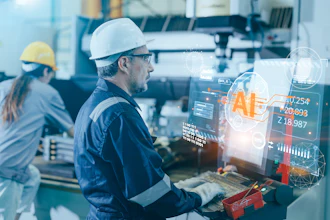
At the heart of this movement is a combination of machine vision and edge processing that allows equipment to interpret what’s happening around it in real time. Instead of just capturing video or data, these systems are actually making sense of the environment, identifying people, objects, movement, and potential hazards as they happen.
What’s powerful here is that the hardware doesn’t have to change every time the use case does. The same system can be trained and retrained to solve different problems, whether that’s pedestrian detection, identifying misplaced inventory, monitoring blind spots, or recognizing edge cases that could lead to an incident. It opens up a much broader set of possibilities than most site managers realize.
What really stands out to me is that this is one of the few investments in industrial environments that doesn’t lose value the moment it’s deployed. In most cases, you buy a piece of equipment and, from that day forward, it slowly depreciates in capability.
With AI-driven systems, it can flip the other way. As models improve and processing becomes more efficient, the same piece of equipment can become more accurate, more responsive, and more useful over time. You’re not just buying what it can do today, you’re buying into what it can become. That’s a very different way of thinking about technology on the shop floor, and it’s one that has real implications for how businesses plan, invest, and operate.
The way we think about industrial equipment is starting to shift, and not before time. Instead of asking how long a machine has left before it needs replacing, we should be asking how much more it can learn while it’s still in service. When intelligence can be added, updated, and refined over time, the value of an asset no longer peaks on day one.
In many cases, it’s just getting started.