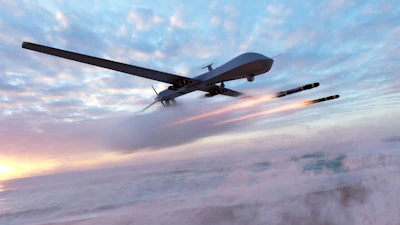
When a U.S. Army unit lost a batch of sensor modules during training, it didn't wait for a traditional resupply convoy. Within twenty-four hours, a domestic supplier network produced, packaged, and shipped replacements by unmanned aerial vehicle to a remote base.
This wasn't a demonstration; it was a glimpse of how modern defense supply chains operate in a digital age. Digital threads link design labs to flight lines, data drives certification, and rapid, resilient production ecosystems are collapsing the gap between ideation and deployment.
From Crisis to Catalyst
Russia's invasion of Ukraine and the ensuing industrial chaos have become a flashpoint for the world's manufacturing powers. Factories have gone dark, microelectronics lines fractured, and entire supply chains turned into strategic targets. Yet amid this disruption, a new industrial race has begun. Both sides now produce thousands of unmanned systems each month, turning battlefield adaptation into an engineering race.
For Washington, the wake-up call has been unmistakable. The United States once commanded the "arsenal of democracy," but now risks falling behind smaller, faster adversaries. The Department of Defense responded with the Replicator initiative and a suite of Defense Production Act programs to mass produce "attritable" autonomous air, sea, and land platforms designed to be built quickly, used intensively, and constantly improved. The mission has been clearly articulated: speed is a weapon.
Billions in federal investment, including Title III funding, Resilience Grants, and capital from the Office of Strategic Capital, are flowing into additive manufacturing, forging, microelectronics, and composites. Deloitte's 2025 report observed that "industrial readiness has overtaken cost efficiency" as the leading priority. McKinsey found that more than 70 percent of A&D executives are regionalizing supply chains to improve resilience.
This is not a temporary surge. It's the early phase of a long-term industrial revival, one with the same spirit and scale as the post-World War II boom that built American Manufacturing Might.
Echoes of the Postwar Expansion
When WWII ended, U.S. planners refused to dismantle the industrial base. Instead, they retooled it. The Heavy Press Program yielded the world's largest forging equipment; aircraft plants pivoted to jetliners; materials labs gave life to the modern aerospace industry. Factories that once produced war machines began turning out airliners, cars, and advanced machinery. The lesson was clear: national security and industrial prosperity are one and the same.
Eighty years later, the U.S. again faces an opportunity to reignite its industrial base. Drones, hypersonics, and AI-enabled platforms are redefining both defense and commerce. The new "arsenal of democracy" is measured not in tonnage, but in data analysis, certification speed, and the strength of cyber-secure, modular supply networks.
The Opportunity for U.S. Manufacturers
For designers, engineers and manufacturers, this moment is a call to action. The Pentagon is investing heavily to rebuild capacity, but funding alone won't close the capability gap. What's needed are partners with certified processes, robust digital infrastructure, and the creativity to translate complex requirements into manufacturing outcomes.
Before Ukraine became a household name, reshoring was often framed as economic policy. Today, it is understood to be a national strategy. Each domestic prototype, verified production cell, and certified 3D-printed component strengthens deterrence, accelerates innovation, and shortens the distance between America's innovators and its warfighters.
Modern suppliers are now expected to achieve in weeks what legacy primes once did in months. The expectations are demanding, but they echo the qualities that powered the mid-century industrial boom: vertical integration, disciplined process control, and unified urgency.
To thrive in this resurgence, manufacturers must master six fundamentals that define the new readiness:
- Integrated Lifecycle Execution: Connect design, prototyping, testing, and qualification through one digital workflow with traceable data from concept to flight article.
- Multi-Process Agility: Combine additive, CNC, composites, finishing, and electronics assembly to minimize handoffs and speed iteration.
- Compliance by Design: Build AS9100, ITAR, CMMC, and materials traceability into the process, not as afterthoughts.
- Surge Scalability: Design flexible capacity, modular tooling, and rapid staffing models to scale overnight.
- Capital Agility: Partner with primes or leverage federal programs to fund new equipment and expand capability.
- Supply Chain Visibility: Maintain digital lot records and conduct controlled audits to expose risks before they reach the customer.
These are not aspirational concepts; they are the standards that will determine who wins Replicator and DARPA contracts and who is left on the sidelines of this renaissance.
Defense Innovation Dividends
The technologies forged in the drone wars won't stay confined to battlefields. Defense-funded research is already reshaping civilian life and spawning new industries:
- Medical and Emergency Logistics: UAVs proven in contested environments now deliver blood, vaccines, and medical supplies across Africa, Europe, and the U.S., their reliability rooted in defense-grade avionics.
- Infrastructure and Energy Inspection: Reconnaissance sensors are being adapted for assessments of power lines, pipelines, and bridges.
- Disaster Response and Surveillance: Autonomous flight controllers and mesh networks tested by defense agencies enable rapid mapping and wildfire containment.
- AI-Enabled Robotics: The autonomy stacks and edge-compute architectures developed for drones are accelerating the rise of ground robots and humanoids for logistics and manufacturing.
Each advance strengthens the link between defense R&D and civilian innovation, echoing how post-WWII investments in radar and jet propulsion made way for modern aerospace, computing, and electronics.
The Next Golden Era
History may not repeat, but it often rhymes. In the mid-1900s, industrial might decided wars. In the 2000s, industrial agility will determine deterrence. America's strength will not hinge on a single technology, but on ecosystems that can design, test, certify, and scale faster than those in other regions.
This is the opportunity before every designer, engineer, manufacturer, and supply-chain participant. The "war machine" of the 21st century isn't built on brute force; it is powered by precision, iteration, and interconnectivity. If the past was about volume, the future is about velocity.
As with the generation that built the Heavy Presses and Apollo engines, today's builders will again lay the foundation for civilian prosperity, including autonomous transport, medical-delivery drones, AI-assisted infrastructure repair, and human-machine collaboration that expands productivity and safety.

Rush LaSelle is CEO of a U.S. manufacturing services provider serving innovators in regulated and high-growth sectors. With more than 30 years in advanced manufacturing, robotics, and digital transformation, he has led growth at 3DXTECH, AddUp, Jabil, and FANUC, and serves on the board of 3DP4ME, advancing socially impactful manufacturing technologies.