Seasats today announced that a fleet of Lightfish unmanned surface vessels (USVs) has been deployed in support of U.S. maritime border security operations.
Launched from the Texas coast into the Gulf of America, the fleet will conduct persistent autonomous surveillance to detect illegal maritime activity, including drug trafficking and other unauthorized vessel ingress. The deployment builds on Seasats' previous support of Operation River Wall along the southern border.
Since January 2026, Lightfish vessels have operated on the Rio Grande in support of federal border security efforts, providing surveillance and early warning alongside crewed patrol assets in an environment that had not previously seen sustained USV operations. The Gulf deployment carries that mission into open water.
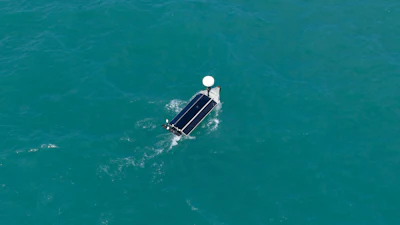
Each Lightfish is roughly 11 feet long and 340 pounds. The vessels are solar powered, capable of multi-month endurance on station, and small enough to be launched and recovered by two people from a boat ramp or the back of a pickup truck. A modular payload bay has carried electro-optical and infrared cameras, signals payloads, and sonar across prior missions, allowing a single hull design to be configured for the sensing task at hand.