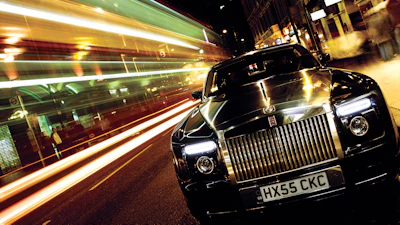
This year marks a triple anniversary for three Rolls-Royce experimental motor cars: the 101EX, 102EX and 103EX. Built during the Goodwood era, the vehicles reached 20, 15 and 10 years since their respective unveilings.
Each of these motor cars played a foundational role in establishing Rolls-Royce’s contemporary design language, technology, engineering hallmarks and commitment to Bespoke individualization.
The cars represent a through-line going back to 1EX, which Henry Royce built in 1919. When Royce found his new Phantom II, launched in 1929, too large and heavy for his own use, his designers produced a lightweight experimental version, 26EX, on an adapted short chassis. It proved ideal for high-speed, long-distance touring on Europe’s smooth, straight roads and entered production as the now rare and highly prized Phantom II Continental.
During the early-to-mid 1930s, Rolls-Royce built 30EX and nine further experimental cars under the codename Spectre as part of the V12 engine development program that would enter production in 1936 as Phantom III.
Drawing inspiration from those experimental Phantom III motor cars, the name Spectre was later revived for the marque’s first battery electric motor car, unveiled in 2022. The last of the pre-Goodwood EX motor cars, 45EX, was built in 1957.
101EX
 101EXRolls-Royce
101EX made its debut at the 2006 Geneva Motor Show. A full four-seat coupé with twin coach doors, it was built on the same aluminium spaceframe as Phantom VII, but 240 mm shorter. Combined with bodywork constructed from carbon fiber composite and power from a 6.75-litre V12 engine, it was designed to have a more performance and driver-focused character than its larger sibling. It also features a lower roofline and shallower glass area; the Pantheon grille is discreetly reclined and extended back across a brushed aluminum bonnet and windscreen surround.
The interior includes the first-ever Starlight Headliner. Comprising hundreds of fiber-optic ‘stars’, it proved an instant sensation and is now a fundamental element of almost every Rolls-Royce motor car, with its own almost unlimited potential for Bespoke individualization. Like its predecessor, 100EX unveiled in 2004, 101EX would find lasting fame as a series production car; the Phantom Coupé launched in 2008.
Phantom Coupé, together with the closely related Phantom Drophead Coupé, was foundational to Rolls-Royce Motor Cars’ development as a modern House of Luxury. 101EX also gave designers and engineers vital insights into materials and construction techniques that would inform the development of the first Coachbuild project of the modern era: Sweptail presented in 2017.
102EX
 102EXRolls-Royce
102EX is the first battery electric vehicle (BEV) built by Rolls-Royce. Also known as the Phantom Experimental Electric (EE), it was created as a one-off, working test bed for alternative drive-train technologies, and, thus, represented the first tangible step on the road that would lead to the advent of Spectre more than a decade later.
One of the most significant engineering challenges was converting everything that runs directly off the engine in a standard motor car, from power steering and ABS to heating and audio to battery power. 102EX had what was then the largest capacity battery fitted to a motor car anywhere in the world. Its wireless induction charging system was also a world first.
Following its Geneva debut, 102EX embarked on a year-long ‘world tour’ of client, media and public events, culminating in an appearance at the Consumer Electronics Show in Las Vegas. This gave owners, VIPs, media and enthusiasts the opportunity to discover Rolls-Royce’s emerging drivetrain technology and share their experiences and impressions. This information proved crucial to engineers’ understanding of the potential and practicalities of BEVs.
102EX’s international odyssey would later be eclipsed by the 2.5 million kilometers Spectre.
103EX
 103EXRolls-Royce
In 2016, the marque commissioned a special ‘Vision’ motor car named 103EX. Hand-built using advanced materials and powered by a zero emissions powertrain, it revealed a future in which Rolls-Royce offered clients an autonomous experience.
The passenger cabin, known as ‘The Grand Sanctuary,’ surrounds occupants with materials chosen to create a feeling of lightness, simplicity and effortless elegance. The seats are replaced with an opulent sofa, which appears to ‘float’ within the cocoon of the cabin.
The 103EX measures 5.9 meters long and 1.6 meters high, the same dimensions as Phantom Extended.
As well as an all-electric powertrain, 103EX includes a digital assistant called ‘Eleanor.’ Within the Vision motor car, Eleanor was conceived to enable fully autonomous driving while also facilitating a seamless digital interface between motor car and owner. This concept anticipated aspects of the Whispers app, which provides clients with a curated digital connection to Rolls-Royce Motor Cars.
United by Heritage
The three vehicles share a single, distinguishing feature.
The use of the Rolls-Royce Badge of Honour, with its overlaid double ‘R’ for the founders’ second initials, can be traced back to the earliest days of the brand, with the first examples appearing on Rolls-Royce 10 H.P. motor cars in 1905. The first badges featured the ‘RR’ symbol in red on a silver background, but in 1931, the process began to change the lettering to black, a style that has remained ever since.
However, the original-style red badge has periodically resurfaced over the decades, albeit rarely and on a highly restricted basis. In 1979, to mark the company’s 75th anniversary, Rolls-Royce fitted red badges to all 212 examples of the Silver Shadow II Anniversary model, together with a single Camargue and the sole Silver Wraith II. Red badges were also specified for the final series of 25 Corniches, the turbocharged Corniche S.
This practice continues today, with red badges occasionally assigned to carefully selected motor cars. Most notably, they have also been fitted to all the Goodwood-era EX models.