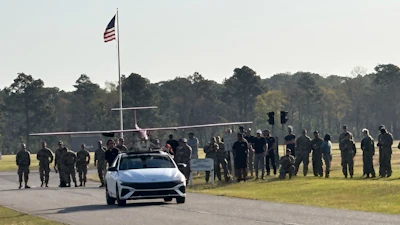
Kraus Hamdani Aerospace (KHA), in partnership with PowerLight Technologies, demonstrated wireless power beaming to the K1000ULE during flight operations at Shaw Air Force Base, sustaining airborne operations without interrupting mission coverage.
Hosted by the AFCENT Battle Lab and sponsored by U.S. Central Command (CENTCOM) and the Operational Energy Innovation Directorate (OE-I), the demonstration paired PowerLight's mobile autonomous power beaming system with the K1000ULE, a DoD Blue UAS Cleared List and Select Group 2 Unmanned Aircraft System (UAS). During the flight, the laser-based system delivered nearly one kilowatt of power to the K1000ULE at altitudes up to 5,000 feet, maintaining Intelligence Surveillance and Reconnaissance (ISR) capabilities and communications in real-time.
The K1000ULE was recently awarded a sole-source $270 million IDIQ by the U.S. Air Force Central Command to support missions in the Middle East. This further establishes the K1000ULE's capability as an operationally relevant group-2 long-endurance/long-range platform in modern theater.
For most aircraft, endurance has historically been constrained by onboard fuel or battery capacity, forcing those aircraft to periodically leave station creating operational gaps. Kraus Hamdani Aerospace has already demonstrated industry-leading performance, achieving a 75-hour world-record flight for a Group 2 UAS. Building on that foundation, the Shaw demonstration validates a new operational capability where energy can be delivered in-flight. This unlocks the potential for multi-month continuous operations in forward and infrastructure-limited environments.
 Kraus Hamdani Aerospace
PowerLight's system autonomously acquired, tracked and transmitted energy to the K1000ULE throughout its flight. The system maintained the laser-based energy link while adapting to aircraft movement and environmental conditions, allowing the aircraft to continue operating at altitude without recovery or ground intervention.
The demonstration reflects Kraus Hamdani Aerospace's established leadership in extended-endurance UAS designed for defense and national security missions that require persistent ISR, resilient communications, and reduced logistical burden. The K1000ULE continues its mission to be the longest endurance group 2 UAS that can remain on station longer, reduce sortie interruptions, limit reliance on vulnerable resupply chains, and maintain coverage during critical mission windows.