Anduril Industries and HD Hyundai Heavy Industries are partnering to design and manufacture a new class of dual-use Autonomous Surface Vessels (ASV) that combines HD Hyundai’s legacy in shipbuilding with Anduril’s speed-to-market, software-defined autonomy and mission systems integration expertise. Together, the companies are developing a modular family of surface vessels for commercial and defense use, including a variant designed to meet the U.S. Navy’s needs under its Modular Attack Surface Craft (MASC) program.
The Navy’s MASC is designed to deliver a distributed, autonomous, hybrid fleet, built to operate and survive in contested waters. Traditional, manned warships cannot meet that demand alone. The Navy needs autonomous, modular vessels that can be produced at speed, deployed in volume, and upgraded continuously with iterative engineering, software updates, and new mission payloads to augment the manned fleet.
Anduril and HD Hyundai’s ASV is built for modularity, speed of production, and mission flexibility. Its open-architecture design supports interchangeable payloads, allowing the same vessel to perform intelligence, surveillance, strike, electronic warfare, and other missions through rapid reconfiguration. The vessel’s distinctive central superstructure provides an unobstructed 360-degree field of view, enabling continuous situational awareness and optimal payload performance.
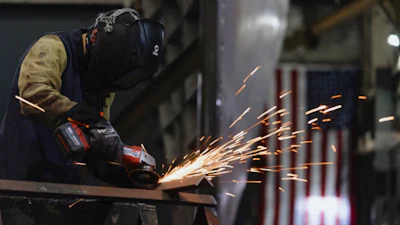
The ship’s autonomy software integrates propulsion, navigation, and payload control into a unified networked system, enabling commanders to adapt missions dynamically and operate with greater situational awareness. Architected from the start with sustainment in mind, the software-defined integration approach enables interchangeability across hardware and software stacks to avoid supply chain constraints and vendor lock. The vessel is built in steel, making it easier to weld, maintain, and repair using the existing domestic supply base—an intentional choice for durability in operations and scalability in manufacturing.
The platform is being developed to demonstrate how an affordable, software-defined surface vessel can extend naval reach and support the Navy’s evolving concepts for distributed maritime operations.
While shipbuilding technology is sharply changing, the principles for success have not. The same formidable physical infrastructure — the sinews of a shipyard that bend metal and put giants to sea—will be required to build an autonomous fleet. To master that craft, Anduril is working alongside HD Hyundai to learn quickly, prove the design, and bring that expertise into the U.S.. The first dual-use ASV prototype is currently being fabricated in Korea, utilizing HD Hyundai’s industrial capacity to validate designs, integrate propulsion and power systems, automate ship functions with autonomy, and prepare for U.S. production ahead of its maiden voyage.
Future vessels, including the MASC variant, will be completely built in the United States. Anduril has invested tens of millions of dollars to revamp a previously retired shipyard in the Pacific Northwest region at the historic former Foss Shipyard in Seattle, Washington. This facility will serve as Anduril’s initial U.S. hub for low-rate vessel assembly, integration, and testing of ASVs for the MASC program.
The Pacific Northwest, home to the wartime legacy of Kaiser Shipyards and the original Freedom’s Forge, offers the infrastructure, supply chain depth, and skilled labor to expand U.S. shipbuilding capacity. The region provides the ideal conditions to re-energize American shipbuilding and grow the maritime workforce.
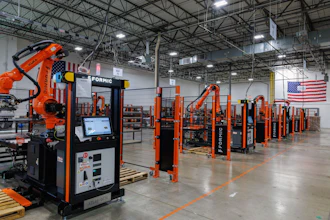
Anduril and HD Hyundai are also partnering with Hadrian to modernize manufacturing across the supply chain and core ship components. Leveraging its tens of millions invested in manufacturing, Hadrian has been involved in design for producibility from Day 1. Its precision automation and rapid fabrication capabilities will produce structural and mechanical components and sub-systems, reducing lead times and enabling flexible, automated, high-volume production that strengthens U.S. maritime resilience.