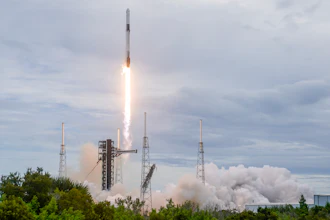
SpaceX recently announced its decision to begin manufacturing gas-turbine blades and vanes in-house, a move that shows how quickly AI infrastructure demand is colliding with industrial supply chains. Gas turbines have become an attractive way for data center developers to secure onsite power while grid connections lag. Demand has risen faster than manufacturers can expand output, and some specialized turbine components can take more than a year to produce.
In August, Elon Musk said bringing blade and vane casting in-house could shorten turbine delivery by as much as 18 months for SpaceX and xAI. While this move could remove an important energy constraint for SpaceX and xAI, it will not shorten the lead time for every other piece of equipment required to turn power generation into operating compute capacity.
Here’s why: A data center cannot use electricity directly from a turbine. Power has to be transformed, distributed and conditioned before it reaches the servers. The servers then produce heat that has to be removed continuously. Transformers, switchgear, chillers, compressors, pumps, controls and other equipment all sit on the same project schedule. The slowest critical component can determine when the facility actually goes live.
Transformers are already a clear example of another area of the supply chain currently destabilized by data center demand. The U.S. Department of Energy says demand for distribution transformers has risen 41% since 2019, while order lead times have increased from three to six months in 2019 to one to two years or longer currently. Large transformers used at substations and generation facilities can now take three to four years. DOE attributes those delays to rising demand, limited domestic production, imported materials and the highly customized nature of much of the equipment.
Cooling equipment is under similar pressure, although lead times vary considerably by product and project. In a recent Trane discussion on data center supply chains, Turner Construction supply-chain manager Mike Fierro said chillers can require roughly 50 to 70 weeks. Developers are increasingly pre-purchasing major mechanical and electrical equipment before designs are fully complete because waiting until the conventional procurement stage can add months to a project schedule.
The investment flowing into these categories shows how quickly demand is changing. Reuters reported in September that manufacturers of power and cooling equipment are seeing growing order backlogs and expanding production to serve the data center market. The beneficiaries extend well beyond chipmakers to transformer manufacturers, cooling companies, power-electronics suppliers and producers of the industrial components inside those systems.
This pattern is familiar in large infrastructure buildouts. Increasing production of one scarce component increases demand on the systems that come next. More generation creates demand for transformers and switchgear. More electrical capacity allows additional compute to come online, which raises cooling requirements. More cooling capacity creates demand for compressors, heat-rejection equipment, controls and supporting electrical infrastructure. The constraint moves until the broader supply chain catches up.
AI makes the cycle especially difficult because compute capacity is expanding much faster than the industrial equipment base that supports it. Factories for transformers, compressors and turbomachinery require specialized tooling, skilled labor, qualification processes and capital. Manufacturers also have to decide how much permanent capacity to add for demand that is growing quickly but remains difficult to forecast. Those investment decisions move on a different timeline than software development or GPU deployment.
SpaceX’s response is one possible answer: vertically integrate the constrained component. That approach is easier for a company with substantial capital, engineering talent and an immediate internal customer. Most data center developers will instead have to secure manufacturing capacity years earlier, standardize equipment where possible and design projects around what the supply chain can realistically deliver. That changes infrastructure planning. Equipment procurement can no longer wait until late-stage construction. Developers need to identify long-lead systems during initial design, understand which components have manufacturing slots available and evaluate alternatives before a single vendor or technology becomes the project bottleneck. Modular equipment and standardized architectures can help by reducing customization and allowing capacity to be added in repeatable increments as the campus grows.
Manufacturers face the inverse challenge. AI demand creates a major opportunity for companies that can increase production of transformers, cooling equipment, motors, drives, bearings and other supporting hardware. It also puts pressure on manufacturers to improve throughput, simplify product architectures and expand capacity without sacrificing reliability in equipment expected to operate continuously for years.
 Freddie Sarhan, CEO, Sapphire TechnologiesSapphire Technologies
Freddie Sarhan is the CEO of Sapphire Technologies, a manufacturer of pressure energy recovery solutions.