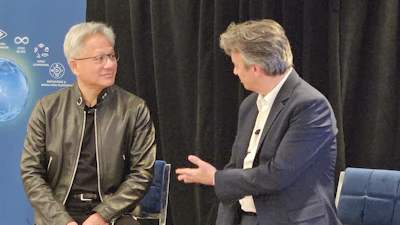
HOUSTON—Nvidia CEO Jensen Huang told thousands of engineers at Dassault Systèmes’ 3DEXPERIENCE World, “Everything will be software-defined in the future.” Then, SolidWorks CEO Manish Kumar told the same audience that most world-changing aspects of artificial intelligence have yet to be invented.
This ambition arrives at a moment when manufacturing is divided by geoeconomic uncertainty, which could shape how the industry adopts AI. Devin Malone, the general manager and brand CEO of DELMIAWorks at Dassault, said global instability causes cash flow concerns for small manufacturers while large firms treat downturns as opportunities to retool and rebuild.
“There's a level of anxiety there because they're afraid that there's going to be consolidation that would effectively make them insignificant in their marketplaces overnight,” Malone said.
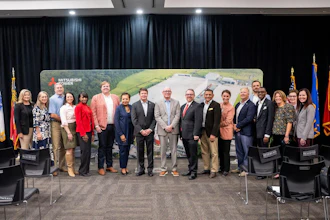
 Dassault Systèmes' 2026 3DEXPERIENCE World in HoustonNolan Beilstein
AI already shapes how engineers work and factories operate, but many still wonder whether it truly amplifies human capability or promises more than it can deliver. For design, SolidWorks Senior Product Manager Craig Therrien explained that the technology can reduce tedious tasks, freeing up time for engineers to explore more iterations and produce better solutions.
The influence also extends into factory floors, where the question becomes whether AI can make real-time production decisions. Eric Green, the vice president of marketing for Delmia, thinks it could—but not for major decisions.
“[The decisions] will be like, ‘I’m going to shut this machine down because it’s trending towards being out of tolerance, and if I let it go any further, I’m going to have a huge quality issue,’” Green said. “I think we’ll see those micro-decisions that help augment the production supervisors and the people who are running the shop floors happening sooner than later.”
However, Malone cautioned against overestimating AI’s ability to solve problems. He compared the technology to sunlight that exposes faults but warned against treating it like a magical button that fixes them. Even with better visibility, humans still need to interpret the data and decide which action to take.
Trust remains one of the biggest barriers to AI adoption. Once trust is established, Malone stressed that companies can delegate authority, but not responsibility.
“We talked to a lot of small, medium-sized companies about running an ERP solution on-premises or on the cloud,” Malone said. “You'd be shocked how many people would say, ‘I'm not putting my solution onto the cloud. I don't want to expose it to bad actors.’
“The truth is, you're far more susceptible to ransomware running the solution on-prem than if you run it on a highly secure, single-tenant cloud. We have to fight just through that mindset change. I would imagine that there's probably a whole host of people that would be willing to run AI analysis, but then they do their own hand calculations before they trust it. The adoption of new technologies is almost generational.”
 General Manager and Brand CEO of DELMIAWorks Devin Malone speaks at Dassault Systèmes 2026 3DEXPERIENCE World conference in Houston.Nolan Beilstein
Cayson Patey, the director of engineering for aerospace component manufacturer Best Aviation Products, illustrated Malone’s point. He explained that his 10-year-old company—with about 40 workers and nine engineers—will run calculations or algorithms manually, verify them in SolidWorks and compare the results with AI outputs.
Even for a small team, AI has played a role in what Patey described as a “fairly top secret project” with Virgin Galactic: developing a giant platform that can lift a spaceship and connect it to a mothership.
“It's a giant tripod, and each platform has actuators that can move in X, Y and Z,” Patey said. “All of them have to be able to move in sync when the spaceship's on it with a 5,000th tolerance. You move it forward for positional accuracy, and you can rotate it to mount it to the spaceship and then mount the spaceship to the mothership, which is nine feet in the air.”
“It's been a very difficult project because of the size and accuracy, but SolidWorks has made it smooth. We'll massage the design, run [finite element] analysis and go, ‘We need to change that because it's taking too much stress.’ The company is excited because we're literally helping get people to outer space.”
While executives like Huang and Kumar predict a software-defined world with breakthroughs yet to come, manufacturers that build trust, structure their data and advance human expertise will be better positioned to shape the future rather than chase it.