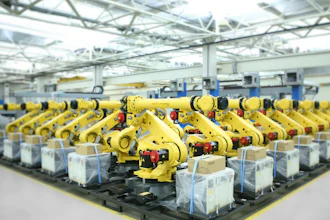
Every manufacturer budgets for equipment failures. Yet an increasing number of production slowdowns aren't caused by failing equipment at all.
Whether it's a line grinding to a halt, a motor giving out, or a shipment running late, the cost hits fast and it's easy to measure. That's exactly why manufacturers keep pouring money into robotics, industrial AI, machine vision, predictive maintenance, and connected automation. The goal every time is the same: better throughput, better quality, more resilient operations.
Modern manufacturing depends on the continuous movement of data. When that movement becomes inconsistent, the effects often appear on the production floor long before anyone suspects the network.
But here's the thing. More and more production slowdowns have nothing to do with equipment failing. They're coming from somewhere much harder to spot - the infrastructure that connects today's smart factory.
Over the past decade, manufacturers have transformed the factory floor. Robotics have become more sophisticated. Machine vision has moved from niche deployments to mainstream quality control. Industrial AI is helping organizations predict failures before they occur, while connected sensors generate operational data at a scale that would have been difficult to imagine only a few years ago.
The More Things Change ...
What hasn't evolved at the same pace is the infrastructure responsible for moving all of that information. Every robot, PLC, industrial sensor, machine vision system, MES, and edge computing platform runs on one thing: reliable communication. The moment that communication gets even a little inconsistent, the effects can ripple through an operation in ways that are genuinely hard to trace back.
And manufacturing systems don't really work in isolation the way office setups do:
- Production equipment is constantly swapping information, often in milliseconds.
- Inspection systems are checking quality while the conveyor keeps moving.
- Industrial AI models need real-time data to function.
- Predictive maintenance platforms are comparing thousands of machine readings at once, trying to catch problems before they shut down the line.
These aren't applications that tolerate delays gracefully. When communication slows, factories don't always stop. More often, they become just a little less efficient.
A quality inspection process begins taking longer to complete. Operators wait for production dashboards to refresh. Autonomous vehicles pause before receiving their next instruction. Remote maintenance sessions become less responsive.
None of these events may trigger an alarm, but together they quietly reduce throughput, increase costs, and erode the operational gains manufacturers expected from their digital transformation initiatives.
Manufacturers have spent decades optimizing the movement of materials through their facilities. Lean manufacturing, Six Sigma, and continuous improvement initiatives all focus on eliminating friction from physical production.
Increasingly, the same discipline must be applied to the movement of data. Information has become another production input. When it slows, production often slows with it. This challenge rarely develops overnight.
Most manufacturing facilities have modernized incrementally. New production equipment is added during expansion projects. Additional sensors are installed to improve asset visibility. Wireless coverage extends into new production areas. Cloud-based applications support maintenance, scheduling, inventory, and analytics. Each project delivers measurable value, yet the underlying infrastructure often evolves one investment at a time.
The result is a factory filled with modern technology operating across a network architecture that was never designed to support today's volume, speed, and complexity of industrial communications.
Take a Closer Look
Manufacturers have gotten really good at measuring equipment performance. Companies track OEE, cycle times, scrap rates, first-pass yield, and machine utilization with impressive precision. Funny enough, a lot of them have way less visibility into the infrastructure actually moving information between those systems.
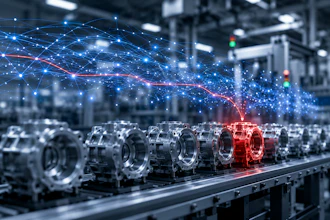
So, when something goes wrong, maintenance teams naturally start by checking the equipment. More and more, though, the equipment isn't actually the problem. It's data congestion, inconsistent latency, or communication bottlenecks quietly affecting multiple systems at once, without ever looking like a typical equipment failure. Understanding how information moves throughout the factory has become nearly as important as understanding how products move through production.
The OT and IT coming together has only sped this up. Systems that used to run in their own bubble now share data with ERP platforms, cloud applications, suppliers, remote support teams, and AI engines. That opens up huge opportunities for productivity, but it also creates new dependencies that weren't there before. Manufacturers are discovering that infrastructure decisions increasingly influence business outcomes.
Edge computing is accelerating this shift even further. Manufacturers increasingly process information where it's created instead of sending every workload to centralized cloud environments. That improves responsiveness for applications like machine vision, robotics, industrial AI, and predictive maintenance, but it also raises expectations for the infrastructure supporting those workloads.
The network is no longer connecting production. It has become part of production. That approach delivers significant advantages, but it also raises expectations for the underlying infrastructure. Data must move securely, consistently, and with minimal delay between machines, edge platforms, enterprise applications, and cloud environments. The network is no longer simply supporting manufacturing. It has become part of the production process itself.
The next phase of smart manufacturing will likely involve even more connected assets, more automation, and greater use of artificial intelligence. Success will depend not only on adopting these technologies but on ensuring they operate together as an integrated system rather than a collection of independent innovations.
For years, manufacturers have focused on making machines smarter. The next generation of manufacturing will undoubtedly bring more automation, more connected equipment, and greater use of artificial intelligence. Those technologies will continue reshaping production.
Their success, however, won't be determined solely by how intelligent individual machines become. It will depend on how effectively every machine, sensor, controller, application, and AI model communicates as part of a single operational ecosystem. Manufacturers have spent years investing in smarter equipment. The next competitive advantage may come from investing in the infrastructure that allows all of that intelligence to work together.
Chris Alberding is Chief Product Officer at BCN.