Western society’s focus has gradually shifted away from local production, relying on distant suppliers to fill the gap. When a defense contractor needs a prototype part in two weeks, the closest machine shop may only be able to deliver it in six. Adding to the strain are a generation of retiring machinists and a dependence on software that appears functional on paper but fails to provide a real-time view of a shop floor.
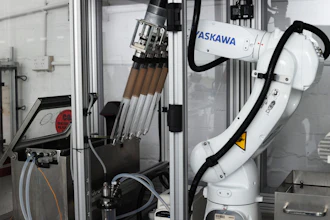
Isembard is a company that sees these challenges as evidence that manufacturing is broken. Claiming the system has lost touch with the act of production, the startup hopes to rebuild the connection by building modular, software-driven factories that combine robotics, CNC machines and its proprietary MasonOS software to produce aerospace, defense and energy components in days rather than months.
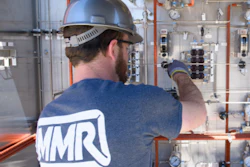
“Our software engineering team actually [sits] in a factory, completely surrounded with what it actually takes to run the facility,” Isembard General Manager Justin Baucum said. “Rather than building it in a silo somewhere else on theoretical processes, they're seeing it every day.”
Isembard envisions a future where operators, owners and machinists interact with one platform, removing the need to jump between disconnected systems. The startup hopes this helps reallocate machinists’ time to their craft and reduce administrative burden.
Baucum estimated that a machinist spends half their time on administrative tasks, such as handling paperwork and tracking multiple platforms. However, the startup wants to flip that ratio to 90-10 by developing Mason in modular stages, beginning with inventory management and continuing with supplier management, quoting and beyond.
 Isembard
“We're hoping to create a straightforward way where machinists, who are [deciding] where they want to go with their career, have the support and opportunity to set up in a smart factory where we've done 80% of the setup and administrative science,” Baucum said. “They can just focus on what they love to do, which is making things.”
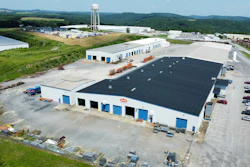
Isembard currently operates four facilities across the UK and the U.S., with a headquarters in both regions and a workforce of 20 to 30 factory employees. Like many startups, it has ambitions of expanding and wants to grow to more than 100 sites spanning multiple manufacturing methods.
While acknowledging that its model could appear competitive, the company views its work as a joint effort with local machine shops and stressed the desire to formalize the informal networks that already link many shops.
Such a collaboration could resolve a recurring pain point for many partners. Illustrating the feast-or-famine nature of the industry, Baucum described a familiar scenario — a shop lands a six-month contract that seems to secure its future, only to scramble once the work ends. According to Baucum, Isembard’s services can create more consistent demand.
“Whether it's a full-scale franchise partner or just an affiliation, we don't have a good name for this category yet, but I think we're just better together,” Baucum said. “I think manufacturing is at the precipice of figuring out what this looks like in the future. I see a lot of interest from business owners wanting to do it in the most streamlined ways possible but typically don't have the space or bandwidth to implement. So they need support.”