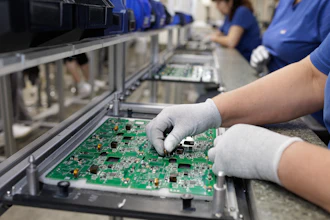
Despite a tempered growth forecast earlier this year as a result of the U.S.-Iran war, Interact Analysis forecasts the global manufacturing industry will experience stronger growth in 2026. In the latest edition of its Manufacturing Industry Output (MIO) Tracker, the market intelligence specialist suggests that semiconductors, data centers, AI and defense are the key drivers of growth and are contributing to investment in other areas, such as power infrastructure and electronics.
The August edition of the MIO Tracker predicted the global manufacturing industry will grow at an average annual rate of 3.2% between 2025 and 2031, as opposed to the previous forecast of 2.9%.
According to analysts, traditional industrial sectors have continued to be hampered by geopolitical shocks and no longer influence overall growth as significantly. While these sectors have remained comparatively weak, it is offset by the rapid growth of newer industries, such as AI, with aggressive expansion plans and large requirements for raw materials, energy and capital.
“The consumer remains a main area of uncertainty,” Senior Data Analyst Jack Loughney said. “Higher borrowing costs, weaker confidence and stretched household budgets continue to limit demand in more discretionary areas, particularly automotive and consumer goods. This leaves the outlook increasingly dependent on investment-led growth rather than a broad-based consumer recovery.
“Overall, the picture remains uneven rather than weak. Growth is becoming more concentrated in a smaller number of capital-intensive sectors, but the scale of investment in these areas is large enough to support gradual improvement in manufacturing through 2026 and into the longer term.”
 Interact Analysis
U.S. outpaces Europe in revised growth projections, as protectionist measures drive onshoring
Asia is projected to maintain its position as the region with the highest growth rate in 2026 at 3.7%, up from 2.9% in the May edition of the MIO. Despite having the weakest growth projections in the previous edition, the Americas will now outpace Europe in 2026, with a growth rate of 3.2% (up from 1.9% in May’s forecast), while Europe’s growth forecasts have fallen to 1.1% (down from 2.2% in Interact Analysis’ May edition).
High energy costs continue to persist in many of Europe’s largest economies, hampering growth, while semiconductors and industrial investment have been a key driver for the Americas.
In the latest edition of the MIO tracker, Brazil and Germany have received the largest negative forecast revisions. Brazil’s manufacturing industry forecast has been revised down by 3.5%, with analysts now projecting the industry will contract by 0.4% in 2026, while Germany’s manufacturing forecast has been revised down by 2%, also resulting in a 0.4% contraction for the country’s manufacturing sector. For both economies, tariffs issued by the U.S. remain a significant barrier to growth, with recent policy changes increasing pressure on exporters.
In contrast, the growth forecast for the United States’ manufacturing industry has been revised up by 3.1%, with an updated projection of 4.6% growth in 2026. Interact Analysis suggested that persisting tariffs and tighter domestic sourcing requirements are driving onshoring efforts across the U.S. manufacturing sector and contributing to additional growth, alongside investment from funds allocated in the 2022 CHIPs and Science act.
However, while such protectionist measures have contributed to higher growth forecasts, analysts also noted the latest section 301 measures, effective from July, levy new tariffs across 60 trading partners, placing upward cost pressure on U.S. manufacturers reliant on imports and may ultimately have a knock-on effect on the growth potential of the U.S. manufacturing industry.