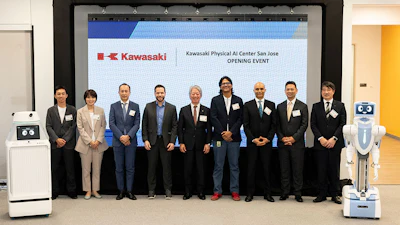
Kawasaki Heavy Industries, Ltd. established its Physical AI Center San Jose, with the aim of accelerating Japan–U.S. collaboration in the AI and semiconductor fields. The company expects the project to advance collaboration with AI developers Nvidia, Analog Devices, Microsoft and Fujitsu.
Physical AI refers to AI that autonomously perceives, reasons and makes decisions in real-world environments and takes physical action through machinery. In recent years, advances in AI have generated significant expectations for the application of the technology across a range of fields, including manufacturing, healthcare, nursing care and mobility.
Kawasaki operates across a broad range of business domains, including aerospace, shipbuilding, energy, plant engineering and motorcycles. The firm anticipates the new center will serve as a base for co-creation activities with AI development players.
The company also aims to develop solutions grounded in real-world operations, beginning with the healthcare and nursing care sectors as well as mobility sectors, by combining physical AI with Kawasaki Group products such as autonomous service robot (Nyokkey), indoor delivery robot (FORRO) and surgical robot system (hinotori) and Robotic Multi-legged Vehicle (CORLEO).
Kawasaki expects collaborations with the aforementioned partners to accelerate the development of these solutions.
Nvidia: Creation of new solutions that integrate AI and robotics technologies across diverse fields, with healthcare as the entry point
Analog Devices: Realization of robots capable of handling a wide range of tasks by integrating AI, voice recognition and sensing technologies
Microsoft: Accelerating the deployment of physical AI solutions by leveraging cloud and AI platform capabilities to help ensure reliability and scalability in real-world operations
Fujitsu: Realization of new value creation in the healthcare domain through the integration of business systems, robotic systems and AI
The center will also collaborate with Kawasaki’s domestic development bases in Japan and with the R&D innovation center “Kawasaki Innovation Centre Europe SAS” to accelerate the social implementation of physical AI by driving the practical deployment of total solutions that incorporate the needs of each region.
Kawasaki plans to continue to make focused investments in high-growth fields such as physical AI (including healthcare) and semiconductors.