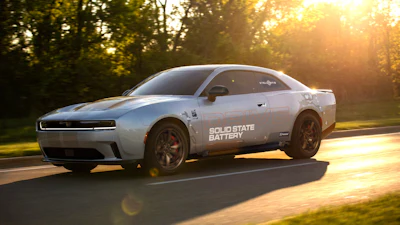
Stellantis has integrated Factorial's FEST (Factorial Electrolyte System Technology) solid-state battery into a Dodge Charger Daytona development vehicle and it's launching a road-testing program to verify performance, safety and reliability.
The automaker said this marks the first integration of solid-state cells into a Stellantis vehicle and a major step towards automotive-grade application.
"Battery development is a balancing act. It's not enough to optimize a single metric. We need a system that delivers real benefits in a real vehicle," said Ned Curic, Stellantis Chief Engineering and Technology Officer, in a statement. "This milestone shows we are bringing solid-state batteries closer to our customers with the potential for longer range, faster charging and lower costs. Just as important, FEST's strong compatibility with lithium-ion manufacturing processes gives us a critical path to scale this technology."
In 2025, Stellantis and Factorial demonstrated FEST cells with an energy density of 375 Wh/kg, ultra-fast charging from 15% to 90% in just 18 minutes and reliability from -30 °C to 45 °C.
FEST solid-state battery cells were integrated into the existing battery pack using a patented new mechanical architecture, designed by Stellantis. Engineers also adapted the control systems and pack design to optimize cell performance while meeting automotive requirements for safety and durability.
With this integration milestone complete, Stellantis and Factorial have started a road testing and calibration program. The testing program will help tune and further verify pack performance and reliability under charging and driving conditions, in addition to vehicle safety.
"We are deeply honored to work alongside Stellantis, one of the world's great mass-market automakers, on this STLA Large-based development car," said Siyu Huang, CEO of Factorial, in a statement. "What we have built together, from cell chemistry to pack architecture to enable real-world road testing, is exactly the kind of deep, full-stack collaboration that solid-state has always required. This milestone doesn't just validate FEST; it sets a new bar for what automotive-grade solid-state batteries can deliver and supports the development of future vehicles designed to meet the evolving needs of drivers."