Lockheed Martin and Hadrian Automation, a California startup focused on building AI-powered factories, have entered into an agreement to add advanced manufacturing capabilities at a Lockheed Martin Missiles and Fire Control site.
Under the terms of the Memorandum of Understanding, Hadrian will deploy its factory-as-a-service model at the site, including a scalable machining and inspection cell, to produce parts for Lockheed.
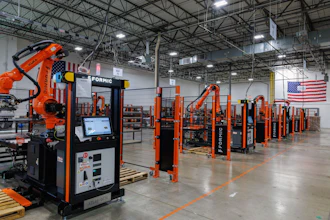
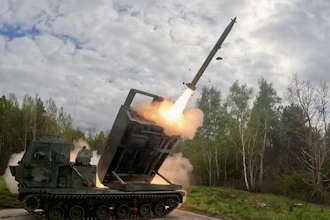
The flexible production cell comprises CNC machines, advanced robotics, and Hadrian's manufacturing execution platform, enabling Lockheed and Hadrian to increase the production rate of a variety of machined parts for missile products, such as the PAC-3 MSE, THAAD, PrSM, and GMLRS.
Tom Carrubba, vice president of production operations at Lockheed Martin Missiles and Fire Control, said the project will help Lockheed increase production to meet munitions demand.
The partners hope to create a more resilient and responsive production ecosystem, one that becomes more capable as demands grow and challenges emerge.
Hadrian believes its factories-as-a-service model will allow defense primes like Lockheed and other industries to scale factories to meet existing or new program-of-record demand for parts, assemblies, or entire products.
Hadrian recently received nearly $49 million in California Competes Tax Credits, nearly half of the $99.9 million doled out by Governor Gavin Newsom. The company is targeting a $52 million investment and is expected to create 650 jobs in Torrance and Northern California.
In July, Hadrian raised $260 million in new capital and announced major expansions of its footprint in California and Arizona.
Powered by Opus, Hadrian's proprietary software stack, these factories are designed to go online in less than six months, creating resilient supply chains, advanced new industrial jobs, and mission-critical components faster than legacy manufacturing systems can deliver.